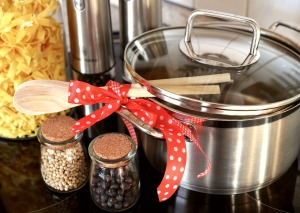
A Master Chef at Work – A Culinary Take on the PhD Process

CookingI have heard many metaphors for the PhD process – ‘a dark tunnel’, ‘a lonely path’, ‘skating like an octopus on wheels’ but I had never thought about doing a PhD using culinary terms. In this ‘Reflections’ article, Dr Nadia Anwar shares an interesting take on her PhD journey.

Doing a PhD is like cooking a very complicated but worthwhile dish on a steady and consistent heat. One needs to be extra careful right from the beginning, keeping in mind all the logistic and practical issues involved in creating one’s delicacy. For instance, how much will the whole dish cost? What kind of hob will be good? Which cooking pot will be best to use? A non-stick pan is highly recommended as you need something that can take the heat and not burn too easily. Do you have all the ingredients? What if one of the ingredients is unavailable? Where will you find it, when…, how…? Who will be the people helping you in your preparation and then in the process itself? These and many other questions will be your preliminary guide to a wonderful cooking experience. You do not need to worry about who is going to share the dish with you for there will be many to lick their fingers once it is cooked.

You will need three types of people according to the function they will perform in your cooking process: Dish sponsors (the ones who are financially supporting you – they can either be your family members or external sponsors), tasters (supervisors), and judges (external examiners). Although all these people are somehow mandatory, in this project, a very significant part is played by the tasters. Once you have got all the ingredients, you start putting them in one at a time at the appropriate stages of the cooking process. Check the fire, is it low, medium or high? If it is low, the dish may never get cooked. If it is very high it may burn the whole thing before it is cooked. So use the proper heat it requires. Sometimes, though, you may need to increase or lower the heat in order to evaporate the extra water or otherwise to retain the proper amount of moisture. You must be flexible.

Now, the tough part (yes! it’s still easy until now); start putting the spices into your pan which although are not your main ingredients, have a crucial role to play in the final texture and taste of your dish. Have you got the right measuring spoon and are you using a non-sticking ladle and moving it only when really needed? Good. A difficult situation can sometimes occur when by dint of bad luck or while busy in cherishing an unavoidably inspirational moment you put a particular spice more than it is needed and there is no way you can undo the act. Do not panic, it may be several times that you make this mistake. The only thing you can do is to save as many ingredients as you can, throw the rest in the sink and start over again. It is advised that you keep extra calm in such dire situations as panicking will only aggravate the situation. Your senior fellow researchers can be of some help as they can listen to your kitchen tragedies and relate their horrible failed experiences to empathise with you. Since their noses are very sensitive to smells, they may even tell you if something is burning.
ChefBe patient with your plans. By this time you may already be performing as a creative and expert cook.  Just keep cooking and adding into your dish all those relevant new spices that have recently been introduced in the market. You will soon realise that your dish has attained a particular texture of its own. Let me tell you the most difficult part is to know when it is cooked or how much time it still requires for the final dish to be ready. Do not worry. Your tasters will tell you when to turn the heat off, decorate your dish and serve. Once out there in front of the judges, even they cannot do anything to save the day if you have made a last moment mistake.

It is time now for the judges to comment. They may reject it altogether, they may make funny faces, they may spit it out or they may ask you to keep cooking it on the same heat for a tad bit longer. If you have really put your energies into making your dish a success and you are lucky then it is highly likely that they find your dish very tasty and start licking their fingers (yes, and even in front of you). I know the whole process is tiring and many a times may test your nerves but be patient. If it is done properly, you will become a master chef!

Nadia Anwar recently completed her PhD in Nigerian drama from The University of Northampton, UK. She is a lecturer in English at the Education Department in Pakistan and visiting faculty member at University of Management and Sciences. Her primary areas of interest are African literature in general and Nigerian theatre and drama in particular.

If you enjoyed reading this article, please share and subscribe to our network! Would you like to share an article in The Hub? We would love to hear from you. Please get in touch – info@aspiringprofessionalshub.com

So you want to do a PhD? – Your survival guide…Part 1

For most PhDs, successfully completing their degree will rank in the top 3 of the greatest challenges they have faced in their lives up to that point. PhDs stretch you on all levels, not just mentally but physically, emotionally and even financially. In the first part of ‘The Survival Guide’, Amara discusses important points for reflection by prospective as well as current PhD candidates.

“So you want to do a PhD?” – Why do you want to do a PhD? Write down your answer, memorise it and make it your mantra. There will be moments when you’ll ask yourself “Why did I do this?” Remember that only crazy ‘special’ people decide to do a PhD. Most of our more ‘intelligent’ friends headed straight into the world of full time employment after completing their degrees but we decided to stay back at University to ‘do’ research. Some of us left reasonably well off jobs for the penury uncertainty of PhDs. Others still, went for the part time PhD (a myth!) route combining it with full time employment. These are my all-time stars!  As a PhD candidate you provoke both awe and pity among the ‘general population.’ Your why is your personal truth so remember that not everyone will respect, understand or support your decision. A PhD is not something you do to fulfil other people’s ambitions, that is almost a recipe for failure – so really ‘Why do you want to do a PhD?’

Brace yourself – We are yet to come across anyone who found their PhD easy. My mantra is ‘A PhD is not just about intelligence but perseverance.’ A PhD is difficult and that’s ok. Embrace the challenge. Truth be told, what is worth achieving that isn’t challenging? You are going down a ‘road less travelled’, making an original contribution to your discipline, solving a problem or creating a product, allowing the world understand something just that much better. Begin with the end in mind. Create a token of what the results of your work mean. It could be a picture from your field study, an incomplete signalling pathway, a diagram of your incomplete theoretical model, the incomplete equation of your predictive model. This is something you are creating and bringing into this world. Something new. It should be difficult. Persevere.

‘No pain, no gain.’

To thyself be true – PhD candidates are unique, there is no one type of student.  You’ve decided (against all wisdom…lol) to study for a PhD. You know your why but deal with the Who? The road ahead is long…so to thyself be true. What are your strengths and weaknesses? Every day you will take both to the job with you.  What are the things that may limit you? No one is perfect but you must utilise your strengths and make allowance for your limitations. If you know you can’t deal with pressure and love the ‘que sera sera’ lifestyle, consider if a PhD is for you. What did you enjoy most about your undergraduate and postgraduate degree? A good qualification is simply not enough. Can you bear to work alone for long periods on end? Are you a committed procrastinator? Are you in a relationship? Is your partner supportive? Do you have young children? Do you plan to have children during your studies? Are you a 9 – 5 sort of person? Do you have a support network? Do you like lab work but hate writing or vice versa? What are your finances like? Will you have to work and study? Can you? What are three things you need to successfully complete that you do not have right now? How can you get them? You cannot change what you do not know. No one starts their PhD knowing it all but embracing an ‘inside-out’ approach can help identify skill and knowledge gaps and seek help.

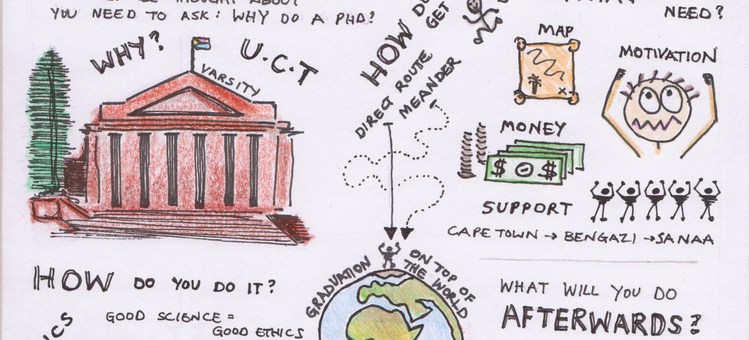
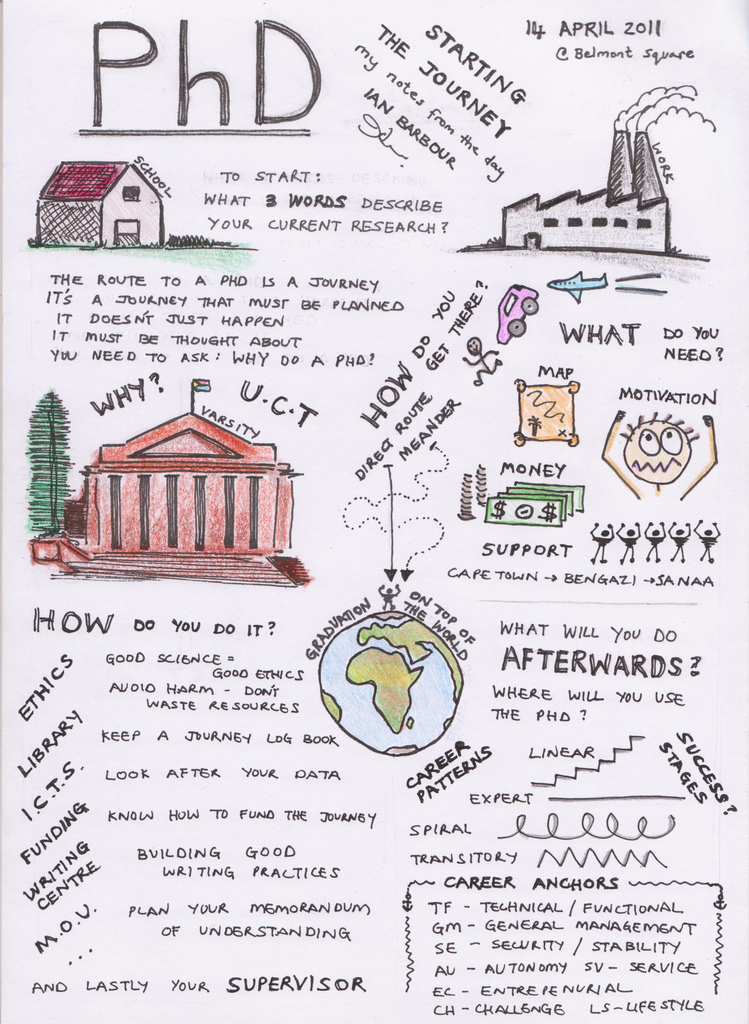
Photo Credit: Ian Barbour https://www.flickr.com/photos/barbourians/
Photo Credit: Ian Barbour

Is s/he the One?  – No, not your significant other but your supervisor. Is s/he the one for you? This is probably going to be the most important relationship successfully completing your PhD depends on. What is your supervisor’s management style? I appreciate that it is difficult to gauge how the relationship will go but do some homework. What do their former and current students say about them? I (Amara) had an awesome supervisor who was a mentor, coach and all round superstar. My PhD was lab based and so we saw each other almost every day – difficult when you can’t stand each other. We had a great working relationship not because she told me what I wanted to hear but what I needed too. She encouraged and critiqued in the same breath. If it was bad, she said so but when it was good, she praised. Sometimes PhD candidates make the mistake of going for a big name over getting a good mentor. We hope to do a post on managing the supervisor relationship in coming weeks so stay posted. Your PhD supervisor is not supposed to be your friend – but it helps if they are friendly. Of all the PhD candidates I know did not complete, 7 out of 10 times it had to do with a breakdown in the student – supervisor relationship.  I have read, observed and heard of some horror stories. Please don’t let that be you.

Murphy’s law aka ***t happens – You’ve studied the protocol, you’ve harassed your supervisor got the equipment, its D-day and you notice your cell culture is contaminated. Five days prep has just gone down the drain. *Hugs* Or you travel for a conference and have your bag stolen, complete with your laptop containing important data (Dropbox is your friend). Despite your well laid plans, there will be setbacks. It could be your fault (you are allowed to make mistakes you know) or due to circumstances totally out of your control like your supervisor deciding to move on to pastures new in a totally different continent! Your Gantt chart has become a distant memory as you bemuse your naiveté when you thought that activity was going to take you 3 weeks but it has actually taken you three months. Your project proposal looks like a relic from times past. A friend lost antibodies worth thousands of pounds simply because someone turned off the wrong switch and shut down his freezer over the weekend!  Things may not always go to plan but remember you are a project manager and a key transferable skill you are developing is that of problem solving. So dig your heels in and keep going. Acknowledge there is a problem but don’t dwell on it, solve it!

HeadshotAbout our writer – After completing a PhD in Microbiology and Food Science,  Amara is developing her career in academia – providing teaching and learning solutions in UK FE and HE Institutions as well as conducting research in Food Microbiology. Amara believes in the combined power of education, mentoring and productive relationships as essential tools for building successful careers. ‘Ignorance can hurt more than sticks and stones.’

If you enjoyed reading this article, please share and subscribe to our network! Would you like to share an article in The Hub? We would love to hear from you. Please get in touch – info@aspiringprofessionalshub.com


Your Job Search – Who you know matters but who knows you matters even more!

Looking for a job can be challenging and an arduous process. It is easy to feel discouraged when things are not working out but please hang in there! In today’s post,  Dr Genevieve Regan, Laboratory Coordinator at the University of the Sciences, Philadelphia,USA shares some strategies for job seekers focusing on the importance of networking.

I should start this with the disclaimer that ‘I am no expert in job searching, career planning, or ladder climbing.’ I am just a person who, after a year of serious searching, has successfully gotten a new position that is better than my previous position and will hopefully lead to better and better things. I can also say that prior to getting my new job,  those qualifications would be all I needed in an author because job searching is gruelling and having gotten a job means something went right for the writer so I would love to hear what they had to say.

In the last 4 months, I applied to 26 jobs, followed up on my application when I could, went to 4 interviews, and got 0 of the jobs I had applied for. My current job came from being in the right person’s mind when a good opportunity became available. Hence my title, “Who you know matters, and who knows you matters even more”.

There are three main points to my networking strategy that I think worked to my advantage. The first is to have a network. You have to think about who you know. I know I lamented, “But I don’t know anyone” but it wasn’t true. I had former classmates and professors, co-workers, and family.

The second point is to have real relationships with these people. I needed to know them but they also needed to know me. Don’t just cold call people and announce you need a job, connect with them. If they are doing the kind of work you are interested in, find out how they got there, find out what interests them about the work, and find out what you can do to help them. Let them know you are looking for work but don’t be demanding about it, give a good picture of your interests and what is going on with yourself. A good relationship needs sharing between both parties.

This leads to the last point; be memorable. People remember people who help them. It doesn’t have to be helping them out with big things, just be a friend or good colleague. Things like sharing an article you think they would like, volunteering to help out on a project or event, or being a sounding board when they need one all can help your relationships.The overriding theme to the strategy would be not to treat it like strategy.  Be the kind of person you would legitimately help to find a job and people will want to help you find a job. They will think of you when they hear of an opportunity the same way you might think of someone else you know when you hear of one. There is an added benefit to my non-strategy strategy. You are connecting with people, and that should be fun. Going for coffee, meeting up at a happy hour, having discussions about topics you both are interested in, these should be fun. In all the job search stress you need fun, so consider it to be part of the process.

If you find networking challenging, you are not alone. Please check out our articles on Networking here and here. If you would like to share an article in The Hub, feel free to contact us @ aspiringprofessionalshub@gmail.com. Follow us on Twitter @AspProfHub.

#MyPhDStory – A Journey of Self Discovery

Self awarenessStudying for a PhD can be a lonely process, however the thoughts you have and the emotions you feel are shared by others in your ‘small’ PhD student community. In today’s ‘Reflections’, Miriam Madziga, a third year PhD candidate at the Institute of Energy and Sustainable Development (IESD), De Montfort University shares some thoughts on her PhD experience so far.
My PhD journey started long before I made my application, it started in my mind, as I gave some thought to why I wanted to pursue a PhD.  I am curious and inquisitive by nature, always wanting to know ‘how’ and ‘why’ things worked the way they did. I also loved writing, which combined with a love for research would serve to my advantage. I knew I wanted to pursue a PhD but did not know what my topic area would be or what doing a PhD entailed. There were more than a thousand questions that flooded my mind. So I did what I do best when trapped in a mentally overwhelming situation, I go on holiday!

I also knew I wanted my topic area to be connected to my previous academic background/ field of ‘Environmental Economics, Waste & Resources Management’ as well as relevant to the world and society at large. I then decided to focus my research on ‘water.’ ‘What about water?’ was my next logical reasoning. I found tons of information and previous research conducted on water generation, production, treatment, supply and remediation; all from ground and surface water sources but very little on production of water from atmospheric water sources. So, I decided to look at the ‘unobvious’ aspect of water where there was very little attention and this was what gave birth to my research topic: Water from air!

Another important factor is the relevance of my PhD research to society today, water is  an element in its abundance on the Earth and yet faces global persistent challenges around the world – this led me to asking the question ‘Why’ and then to ‘Finding out what I could do about this’. My research is investigating the use of condensations systems to extract clean drinking water from air’ and I have decided to apply this especially to poor communities.

What has my PhD experience been like? It has been unlike any other thing I have ever experienced. When I first started, I felt like an octopus on skates trying to keep my balance while navigating through new territory. Nothing really prepares you fully for a PhD like doing one. Where I seemed lacking in skill or knowledge, I quickly sought assistance and applied myself. The transition onto my PhD was made smoother because my University provided doctoral training courses which gave me a better understanding of what the process was like and what skills I needed to develop to succeed.

My PhD journey has been one of self-discovery, especially of new skills and abilities I did not know I had. I have developed excellent organisational skills; planning is very crucial to enable me progress with my PhD as well as have a life outside of it! I set weekly and monthly goals for my research and look forward to rewarding myself with adventure trips such as: skydiving, scuba diving, hiking, or snowboarding.

My time keeping has significantly improved. As an undergraduate student, I recall being late so often to lectures that I was mandated to take a ‘time keeping’ session – to which I arrived late! However, the contrast between who I was then and now has been huge and I am pleased to see the transformation in my research as well. I can tell you to some degree of precision what my calendar is like from today even up to the end of the year – all a credit to planning management.

I suppose my mental preparation was what paved way to the resilient spirit which kept pushing me through tough times, challenges and setbacks. The biggest challenge of all for me was funding as I am self-funded. This meant that being a PhD candidate was akin to working a regular job with no income for a minimum of 3 years while simultaneously sourcing funds to enable me conduct my PhD research.

A sustaining factor was the desire within me to pursue a PhD despite all odds. Call it kismet, but suddenly opportunities began to emerge to aid me along the way. Assistance in form of business consulting opportunities, networking and monetization through my blogging platform and sales of products I had made and books I had published. I took advantage of every opportunity that came my way. This in turn opened up more connections and networking opportunities with people, industry and other Universities.

My PhD journey has also been sustained by the self-motivation that I continue to generate within myself. When the going gets tough; I find comfort in the place of prayer and meditation, laughter and joy amongst friends. I build endurance, clarity and stamina at the gym and while playing roller derby with my team Roller Derby Leicester, and most importantly the love and support of my family and loved ones.

So, if you aspire to elevate yourself to the league of extraordinary researchers, develop new skills, make new connections and progress in your career, I will most definitely say ‘YES’! Go for a PhD!!

#MyPhDStory – My PhD Life lessons

We were pleasantly surprised about the response to our article discussing myths about PhDs. Studying for a PhD can be a life changing process; successfully completing one provides the opportunity to learn not just about your discipline but about yourself as a person. In this article, Amara reflects on some of the most valuable life lessons she learnt while studying for her PhD.

Perseverance can be more important than intelligence – We had a saying in my lab that became my PhD mantra – ‘Never give up!’ Everyone knows that doing a PhD comes with its own unique challenges but I severely underestimated how difficult it was going to be. Nothing I had experienced during my undergraduate degree prepared me for starting a PhD. Six months into my PhD, sadly, my Director of studies (Supervisor) passed away suddenly after a very brief illness. He was more than just a supervisor but a mentor and someone I respected and liked greatly. I seriously considered throwing in the towel but I remembered ‘Never give up.’ My supervisor had given me a golden opportunity and I was going to keep working until I got to the end. There were many more obstacles along the way but I kept building up my perseverance muscles. If you are doing a PhD now and feel like giving up at some point, don’t worry, it is perfectly normal. The myth is that PhDs are super smart geeks but the truth is they’re just a tenacious bunch. See your PhD as a marathon and not a sprint.  Your intelligence may get you into a PhD but perseverance is a requirement for successful completion.

Success = 1% inspiration + 99% perspiration!

Learn to manage failure – Learning not to take failure personally but to use it as a growth tool. No one tells you that about 75% of your experiments will not work the first time. That you will spend an uncountable number of hours writing an article, finally getting all co-authors happy with it, send it off to a journal and get a rejection email three months later! I learnt to toughen up. Easy? No. Necessary? Yes. I taught myself to see criticism as encouragement. Up until starting a PhD, I had never really had to deal with failure. I thought I was a great student – I had finished with a 1st after all – I laugh now at how unprepared I was at the beginning. I learnt the hard way that failing is an event and the best way to deal with it was to get back in the ring and keep punching. I was only a failure if I allowed failing to stop me in my tracks. Towards the end of my PhD, I noticed that I had developed my problem solving skills and was better equipped to handle issues – even those unrelated to my PhD as well. For more information on dealing with rejection, see here.

Who you know is just as important as what you know – I am an introvert by nature. The nature of PhDs means that you work on your own for extended periods of time which suited my personality to a T. I soon realised how important it was to create and cultivate productive relationships. A PhD is an independent project, not a loner project. I was encouraged to start attending conferences from my first year. At first, I saw these meetings simply as opportunities to present my work but I have learnt to use them to expand my network.  Networking is not just about about finding employment opportunities but can even help provide solutions to some PhD issues. I was able to solve a problem I had been struggling with for a few months in a thirty minute conversation I had with a Professor at a scientific meeting. Your PhD supervisors will have a significant influence on how your PhD progresses and is one of the most important relationships you will have during your PhD and even after you finish. The key word with regards to relationships is ‘productivity.’ Some of my relationships did not survive my PhD because I could not ‘turn up’ at every event. On a personal level, I would never have made it through without friends and family. There were some dark days but my cheerleaders always had my back and I am forever grateful.

Read More – The PhD Survival Guide

Master your subject AND develop your skills – A PhD is awarded for making an original and significant contribution to  knowledge in a specific discipline. This takes a considerable amount of work and effort but I found out that it was important for me to develop my skills profile as well. Having all that knowledge was great but as I got to the end of my PhD and started looking at job advertisements, I realised that transferable skills were just as important. Even though my PhD was lab-based, I realised that there were many opportunities to develop my leadership, creative thinking, problem solving, communication, organisational, management, teamwork and even enterprise skills. I started my teacher training during my PhD as I wanted to have something extra to offer potential employers in addition to my qualification. During my PhD, I realised that I actually enjoyed managing projects almost as much as working in the lab!

Lab-based PhD not Lab-based Life – I learnt that I needed an ‘escape’ from the lab ever so often. I know many PhDs seem almost superhuman and are always the first to get into the lab and the last to leave EVERY DAY but that didn’t work for me. I spent long hours in the lab, weekends, overnight at some points…but I made sure I had some outside interests. I volunteered for a children’s charity at least twice a month. I registered to become a STEM Ambassador. I started a small business (thanks mum). Studying for a PhD does not mean you cannot be entrepreneurial. I do not know many well paid PhD candidates and financial security is important to me. I realised that there would be life after my PhD and there were no guarantees with regards to employment. It was a balancing act but what better way to learn management?

There is still some work to be done regarding diversity in the sciences and academia – particularly in senior positions. While things are getting better, I believe we still have our work cut out. There is still gender bias and an under representation of ethnic minority females. This ignited a desire and passion for engaging with young people to encourage them to think about careers in science (We will be writing more about this but we also welcome any thoughts on how this diversity gap can be closed).

Read more – 4 Strategies for an effective relationship with your supervisor

Enjoy it – I enjoyed doing my PhD, not everyday but as a whole. We hear a lot about the ‘burden’ of a PhD but there are great moments too. Some of my closest relationships today are people I met while doing my PhD. I have been mentored by two awesome scientists. I have had the opportunity to go around the world to present my research which I would not ordinarily do if not for doing a PhD. I am more confident speaking in public. I now question everything; there is just something about reading hundreds of papers to write your thesis that makes you begin to think critically about everything else. Don’t spend the few years of your PhD complaining (well not every day). It is a challenge but who doesn’t love a challenge?

I may come back to this topic because it is by no means exhausted. More importantly, I would like to know what lessons you learnt from graduate school or during your PhD. 

HeadshotAbout our writer – After completing a PhD in Microbiology and Food Science,  Amara is developing her career in academia – providing teaching and learning solutions in UK FE and HE Institutions as well as conducting research in Food Microbiology. Amara believes in the combined power of education and productive relationships as essential tools for building successful careers. ‘Ignorance can hurt more than sticks and stones.’

If you enjoyed reading this article, please share and subscribe to our network! If you have an article you would like to share with our readers, please get in touch – info@aspiringprofessionalshub.com.