The Art of Acting II – Impact of ‘Type’ and ‘Casting Choices’ in Finding Roles and Honing Your Craft

Recently, we featured an article on the Art of Acting by Shauna Blaize, an actress, model and film producer. In the article, Shauna shared her perspective and the “reality” facing budding actors in the film industry. In today’s post, Shauna reflects on how type and often race play a part in casting choices and how she is showcasing her own abilities as an actor and a producer.

We all have a type and when casting directors look at us they see the girl next door, the sassy girl, the best friend, the leading lady, etc and quite frankly it may not be what you or your friends/family see when they look at you.  But again we are not looking at our personalities or our inner essence; we are looking at ourselves with a critical eye, knowing the type we fit into and how we can sell that type. In other words how our type fits in with the need they are trying to fill.

Type has a few branches; it’s not only if you have straight or curly hair, if you wear glasses, or if you are short or tall or have a “look” that is more on the “businesswoman” side versus a “hippie chick.” It goes deeper than that. For instance I need to know that as a Black woman I will be viewed for certain roles. Roles such as the neck twisting/”around the way” type girl. If you want to go even deeper, I am a woman of mixed ethnicity and “light skinned” so I will be viewed as that “pretty light skinned chick” from the projects that is considered a “prize” because let’s be honest, I have a lighter complexion.

We look at Kerry Washington (Scandal) and recent Emmy winner Viola Davis (How to Get Away With Murder) and it seems that it’s all good for actresses of color but we are still quite far behind.


#CareerChat – What Does It Mean To Be A Good Leader?

leadership-article
Image: Image Basket

Are we born to lead or follow? Are there any certain, genetically determined traits found in some people that naturally puts them in a leadership position? In today’s post, Dr Monika Stuczen shares her thoughts on what it takes to be a good leader and simple tools that make for effective leadership. Enjoy reading!

I was born into an average working class family and grew up under communism in my country. I can’t say that my parents or the society helped me to become a confident child. I was rather treated like someone without any rights to speak, especially at school. If you spoke out loud, it was seen as a lack of respect towards adults and teachers so we always kept our thoughts and opinions to ourselves. As a young person, I was so shy that even a trip to the shop was a challenge because I had to speak and ask for what I wanted. I so hated this feeling of shyness and over years was trying to do everything to overcome it by exposing myself to many challenging situations which required me to be more open and take a lead.

#WideningParticipation : BME & STEM Engagement – Can we do more?

Big Bang Fair
Image – Central Sussex College

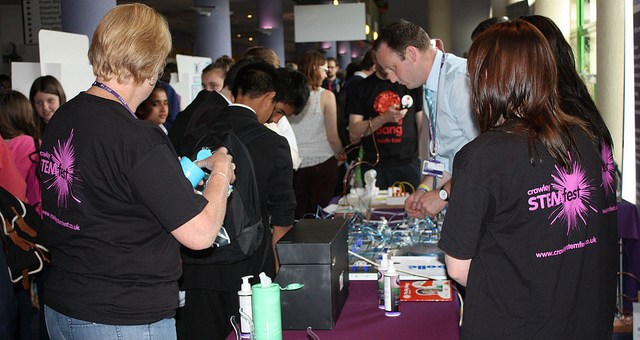
Recently, there has been a lot of discussion focused on how to deliver diversity within Science, Technology, Engineering and Maths (STEM). However it is still the case that a lot of work remains in addressing the underrepresentation of black and minority ethnic (BME) individuals, disabled people, women and those from socially disadvantaged groups in STEM.  In this article, Hephzi and Amara discuss how decision makers within STEM can engage with BME communities to ignite a passion for STEM in young people and create an awareness of career opportunities within these sectors.

Up until 2011, the concepts of ‘science communication’ and ‘public engagement’ were alien to me. I had never been to a science fair, a science show or even visited a science museum! I had never sat in an audience where someone or a group of people discussed the range of opportunities and possibilities which could arise from pursuing a career within STEM.

I belong to two categories classed as underrepresented audiences in STEM; I am black and female. My recent discovery of the variety of ways in which scientists engage with the public is despite the fact that I have always been interested in science. I studied all three science subjects – Physics, Chemistry, and Biology – as well as Maths for my A’ Levels and have ‘stayed in science’ till date – working towards a PhD in Cell Biology. So, how does one with such an interest in science have such a myopic view on the diversity of career pathways within it?

“Writing is Fun and Escapism.” -A Journey into the World of Fiction

Are you thinking of writing your first novel or have you started writing but need that bit of inspiration to help you complete your first manuscript?  In this article, John Hancock, Associate Professor of Molecular Biology and Author of several academic textbooks in Molecular Biology and Cell Signalling shares his experience of writing fiction. John also shares some advice for prospective authors on taking the plunge into writing that first novel. Enjoy!

Writing is both fun and escapism. Having written quite a lot of non-fiction having the chance to write a story is refreshing. There is no right or wrong way to do fiction, by which I mean you can write about anything as long as it, hopefully, comes across as engaging and enjoyable. 

The Entrepreneur’s Corner: Time Management for Busy Entrepreneurs

You’ve taken the plunge and started working on transforming your business from an idea to reality. Things are going well, customers are taking interest, new ideas for expansion but growth comes with its own pains. How do you keep up the pace? How do you grow your business and manage the responsibilities that growth entails? In today’s article, Adeyinka Ojo, a business consultant, shares some ideas to enable you deal with time pressures on your journey to success.

Entrepreneurs are a special breed. You have a 24/7 job. If you are like me, your mind rarely shifts from your business. In the first few weeks of starting my business, I discovered that there never seemed to be enough time in a day to get everything done! Surprisingly, I also realised, from talking to other entrepreneurs that I was not alone. I recently spoke with an entrepreneur in another country and marveled at the commonalities in how we work – which is pretty much non-stop.

Knowing that your job as a small business owner requires you to wear many hats and work long hours – some of my best ideas come into my head between 2:00 – 4:00 am! – you may ask yourself ‘How can I keep up with this pace and avoid burnout?’

Here are four tips that you can use to keep yourself on track.